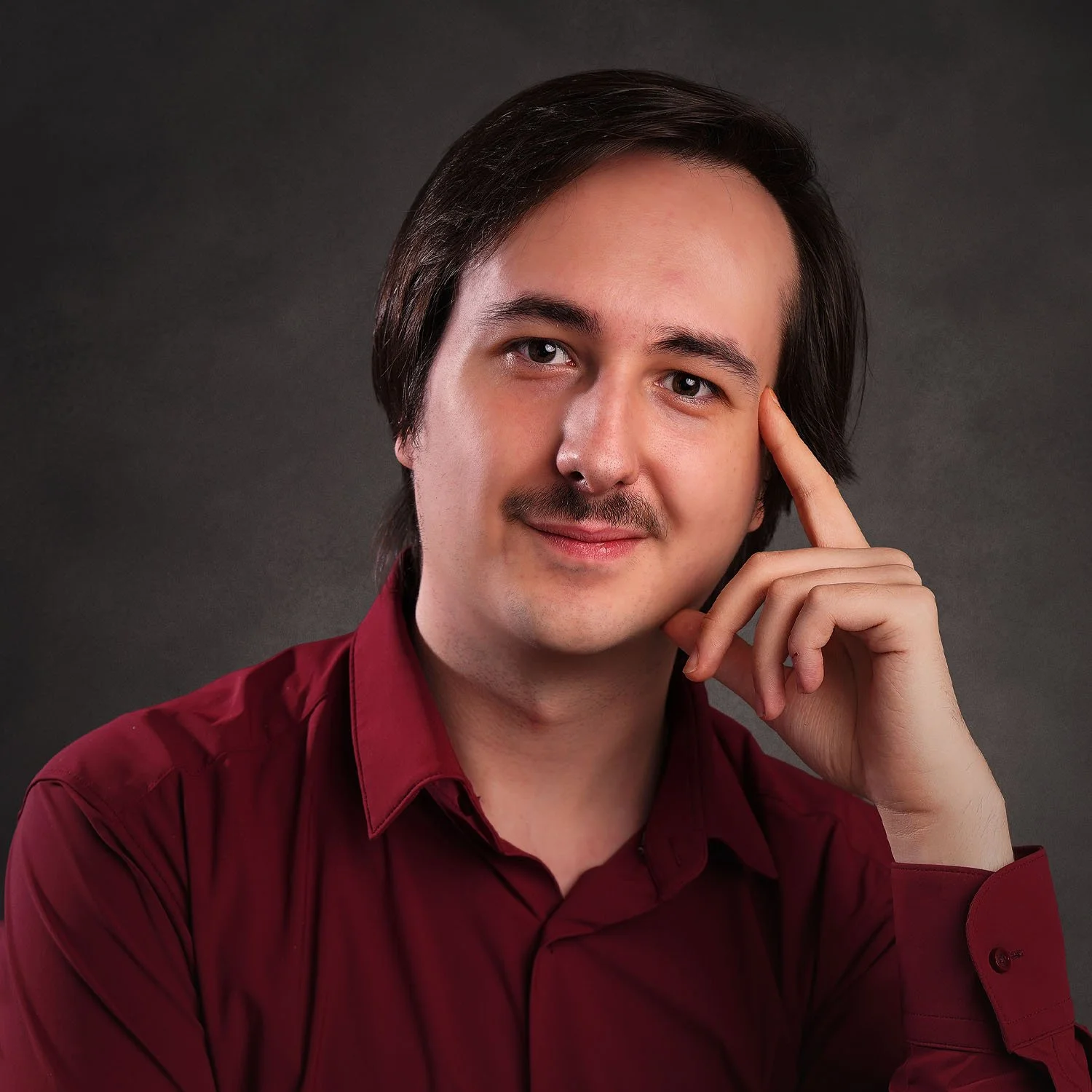
An Author and a Voice Actor Walk Into a Bar
Following the release and completion of the Detective Dion mystery trilogy, I met up with Hayden Coward, the voice actor who brought its characters to life across all three audiobooks.
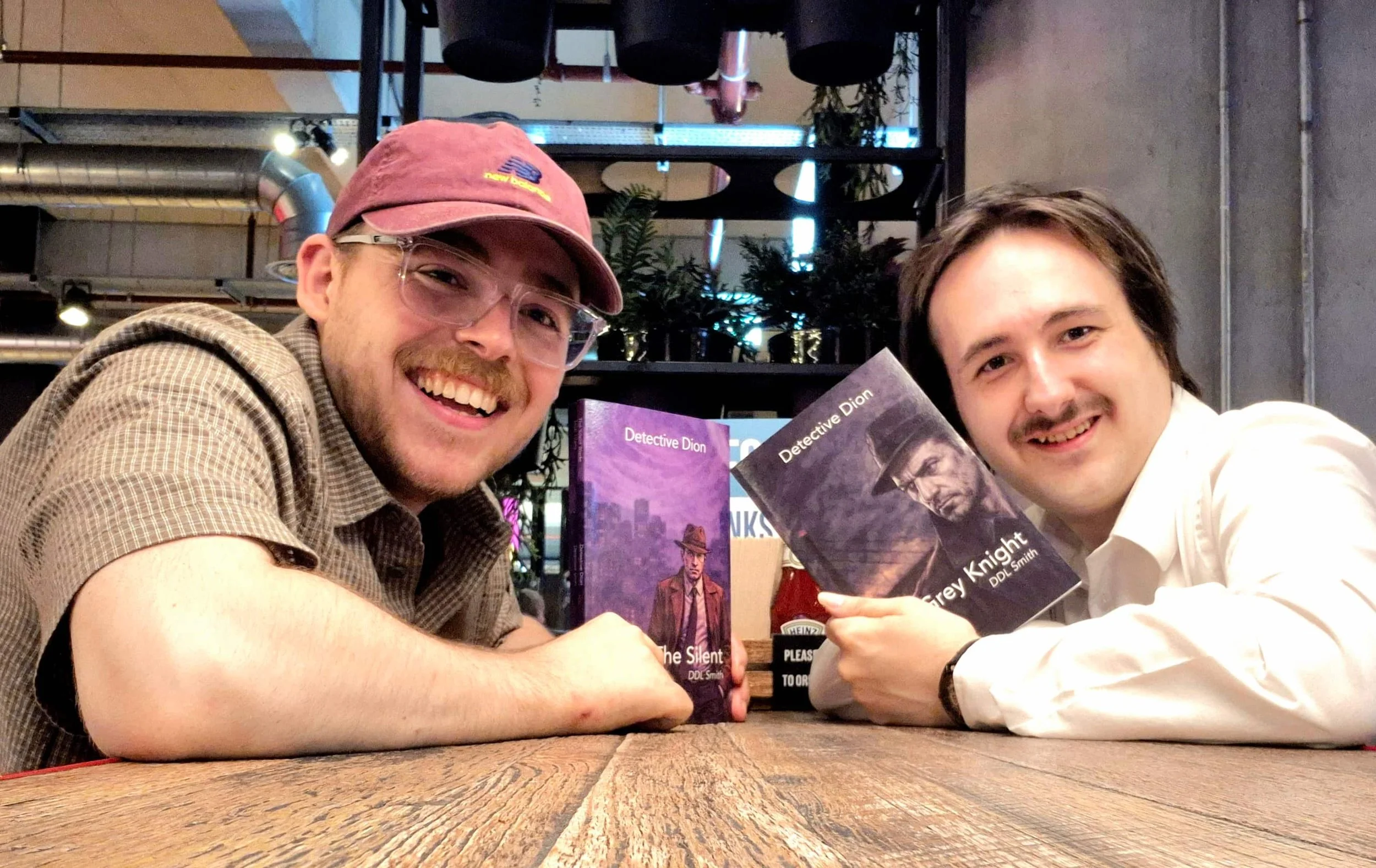
Waterloo Station was sweltering on that Tuesday afternoon. The sort of heat that clings to London’s concrete and follows you indoors. As an author who spent much of his youth acting in theatre, I have always been fascinated by the moment a fictional character becomes something more than words on a page, the voice, the posture, the rhythm of their movements, and the subtle ways in which they differ from the person portraying them.
Writing establishes the outline of a character, and then a vocal performance adds texture. An audiobook narrator must somehow create all of that without large spaces to physically perform, often while switching between several characters within the space of a few sentences.
Hayden attended the University of Exeter before going on to drama school in London. His involvement in theatre began when he was around nine years old, playing the Artful Dodger in a school production called Olivia, a female-led adaptation of the musical Oliver!
He recalled that there were not many boys interested in drama at his school, so adapting the production around a predominantly female cast made sense. Hayden loved playing the role and soon realised that acting was something he wanted to pursue seriously.
Later, after taking a couple of lessons in audiobook narration, he discovered that voice work felt natural to him. He began with an inexpensive microphone, recording early projects and reinvesting the money into better equipment. That gradual process has allowed him to build a catalog of more than 30 audiobooks, including all three Detective Dion novels.
We settled down with a cider and began discussing the world we had separately inhabited over the previous few years, I through writing it, and Hayden through finding the voices that would allow listeners to enter it.
His favourite character, he told me, was Theodore Stevens.
“I was always enamored with Stevens. He was fun to play, and then Dion was always a miserable man on the side, so I always found their dynamic quite fun.”
Stevens is warmer, more openly enthusiastic, and, at times, more chaotic than Dion. Their friendship allowed both characters to reveal qualities that might otherwise have remained hidden. Dion’s restraint gave Stevens room to be expressive, while Stevens frequently managed to draw humanity from a detective who would usually prefer to keep it buried beneath work.
“Playing Dion in a husky way was a lot of fun. It was nice to have the creative liberty with Gregory, with a Scottish accent, and then new characters came in, like Victor Stanton.”
I had always envisioned a wide variety of characters within the novels, while deliberately leaving parts of them open to interpretation. A reader should be able to form their own connections and impressions rather than having every movement, feature, and vocal quality dictated to them.
Hayden had noticed that openness. He explained that one of the challenges for a voice actor is deciding how much definition to give a character while still leaving space for the listener’s imagination. Every creative decision, a regional accent, a vocal weight, a hesitation, adds character, but it also narrows the range of possible interpretations. The narrator must therefore make each voice distinctive without trapping the listener inside an overly rigid performance.
We moved on to the third book, Detective Dion: Grey Knight, which follows the shooting of Detective Stevens at the end of the second novel.
“Each book can stand alone. Book one is its own case, then book two is another case, and book three can continue on. It was weird having a book with no Stevens. It’s Dion doing his thing, and then there are some chapters that go back to Stevens. I thought, ‘Ah, maybe there’s more to Dion. He does care. He doesn’t want to say it, but he cares.’”
That was one of the central emotional aims of the third novel. Removing Stevens from Dion’s immediate surroundings creates an absence that Dion cannot ignore. He is forced to operate without the person who most reliably challenges his isolation. The story can then explore how much Stevens matters to him, even when Dion is incapable, or unwilling, to articulate it.
Hayden continued, “It was nice that Dion being on his own gives space for all these smaller characters, like a taxi driver. It gives more creative license. The driver is only there for ten seconds, but he can have a different voice.”
I included those smaller characters throughout the novel to interrupt moments of tension and make the world feel as though it continues beyond the central investigation. A taxi driver, receptionist or stranger in a bar may appear only briefly, but each offers a glimpse of a life unfolding outside Dion’s immediate concerns.
For a narrator, those short appearances present a different kind of opportunity. A minor character may require only a handful of lines, but the voice still needs to communicate age, temperament, background, and purpose almost instantly. There is no chapter-long introduction in which to establish them. Their identity has to arrive with their first breath.
Our conversation drifted towards a particularly unusual character, Dion’s sister, Elise, whom he encounters in Berlin.
I wanted Elise to function as a reflection of Dion rather than as an entirely literal presence. A way for him to break down problems and hear his thoughts outside his own head. Throughout the novel, she avoids direct interaction with the physical world. She does not open doors, appears unexpectedly, and seems to possess whatever information Dion possesses, regardless of whether the reader has seen them discuss it.
I had worried that some of those hints might have been too subtle, but Hayden assured me that the intention came through.
“She turns up, and then she’s not there. It was odd. Why is she so odd? Then the final chapter, where Dion talks it through with the doctor, clears it up. Dion is clearly aware of it, but uses it to his benefit. It really works as a plot device, but also as a character choice for Dion.”
That distinction was important to me. Elise is not simply intended as a late twist. She reveals something about how Dion’s mind protects, challenges and occasionally comforts itself. He understands more about her presence than he initially admits, and the conversations allow him to confront ideas that he might otherwise suppress.
Hayden then asked me where the books were. Once again, this had deliberately been left open to interpretation. In my own imagination, the first novel took place in a city resembling New York. The second book’s opening unfolded somewhere around Madison Square Garden, while the police station stood closer to the waterfront. However, I avoided naming the city in the first two books because I wanted readers to place the characters somewhere familiar to them.
A reader in London, New York, Toronto, or Sydney could construct their own streets around the investigation. Maintaining it became considerably harder in the third book, when Dion travels through recognisable locations in London, Berlin, Stockholm, and Malmö. Once real geography entered the story, the unnamed home city became more conspicuous.
I returned the question to Hayden. He had spent three books with the characters in much the same way a reader had, building his own interpretation from the available clues.
“I always thought it was somewhere in England, but then in book three he gets a flight to London. Words like ‘bullpen’ made it feel kind of like New York, but then you have Chief Constable Harris, and they’re all speaking with British accents.”
The result is a curious fictional city assembled from British institutions, American terminology and the listener’s imagination. Perhaps its uncertainty has become part of its identity.
I asked Hayden about the accents in the third audiobook. Alongside the returning characters from our “anywhere” city, Dion encounters people in London, Berlin and Malmö.
“German was easier, but I have never claimed to be able to do Scandi. A lot of my books would have a Scottish character or someone from the West Country, accents I’m comfortable doing. For people who just follow the author, it’s fine. However, when my mother listens to the books, she’s like, ‘Oh, another West Country boy. Another Scottish woman. Fantastic.’
“With Scandinavian, I realised I was slipping in and out of Welsh. So it was interesting and a challenge, but that’s the point. When we were talking and going through some Swedish pronunciation guides, I was thinking, ‘Oh, what is he writing? How much of this is in Scandinavian?’ There was a news reporter speaking German, which was the only foreign-language section in the book, but that was okay. I can do German.”
The exchange highlighted something readers may rarely consider, every new location creates practical performance questions. A place name that occupies half a line on the page may require several attempts, a pronunciation recording, and a discussion about regional accuracy before it can be spoken convincingly.
I raised the fact that we had both been theatre kids, and we began reminiscing about the process of getting into character. On stage, an actor may spend an entire performance inhabiting one role. Once the character’s voice, movement and internal logic have been discovered, the actor can remain within them.
A voice artist does not have that luxury. They may move from narration into Dion, then Stevens, a taxi driver and a German reporter, in rapid succession. Each character needs to sound immediately recognisable, yet the transitions must never distract from the story.
I asked Hayden how that experience differed from playing a single role in the theatre. He explained that voice work can be more difficult because the performer is physically confined within a recording space. There may be little room to move, and every gesture must remain controlled enough to avoid creating unwanted noise. The body still informs the performance, but much of its expression has to be compressed into sound.
“The big challenge I find in voice-over is, how do I translate the physical into the voice? When somebody hears the voice, I want them to imagine the character from the voice. How can I tell 100 percent of a story with 30 percent of the tools?”
That question stayed with me. Writing and voice acting face versions of the same limitation. A novelist builds a world from marks on a page, a narrator rebuilds it using breath, rhythm and sound. Neither has access to every tool available to theatre or film, yet that restriction invites the audience to participate. The reader or listener supplies the missing streets, faces, and gestures.
Before leaving to catch our respective trains, we joked that Hayden was fortunate his favourite character had not been killed off. Considering Stevens’ experiences during the trilogy, “fortunate” may be doing some fairly strenuous work in that sentence.
Our conversation reminded me that an audiobook is not simply a book read aloud. It is a second act of interpretation. Characters I had known privately for years had passed into another person’s imagination and returned with voices, accents and small human details that had never existed on the page.
Somewhere between the author, the performer, and the listener, they had become something neither of us could have created alone.
A full recording of our conversation is available at ddlsmith.com, featuring more discussion about the writing and recording process, along with some of our accent experiments.
Hayden Coward’s work spans more than 30 audiobook productions and can be found through major audiobook retailers and on Amazon at this link.
Further information about the Detective Dion trilogy, in both written and audio formats, is also available here.